For My Young Friends (And maybe the not so young ones also)

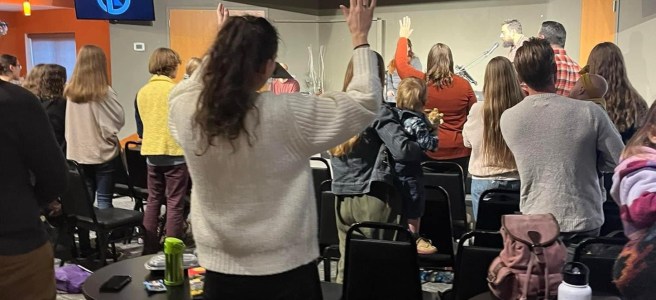
From my vantage point at the back, I noticed her radiant smile and his hand raised in worship. Two worshipers juxtaposed across my line of vision. These teens unashamedly and joyfully responded to God, their faith in Jesus on display, and it brought me to tears.

I had spent the worship service much like I spend it every week— passing out paper and markers, rummaging for other quiet activities to keep little hands busy and little voices quiet, hearing bits and pieces of the sermon, bouncing a baby on my hip, whispering variations of “Shh time to stop talking, Pastor Shayne is praying.”—in short, doing every thing I could to keep my children from distracting others. 

Our small church doesn’t have a children’s ministry, so everyone is together. I love much about this arrangement. My children experience all the aspects of church together. They can tell you what the communion elements mean and why we celebrate it every week. They see adults pray and sing.They get to see Daddy play the guitar and preach sometimes. But I’d be a liar if I said it is easy. Sometimes I’m bone tired, weary, and wish I could listen to the sermon without my four little “distractions” in tow. Sometimes I hand out markers with an overwhelmed, grudging heart. And more than once I’ve wished I could send them along to their own classes and call it a day.

So it was at the end of another such service when I noticed two teenagers simply, humbly, worshiping. Neither was putting on a show or drawing attention to themselves. Several thoughts intersected in my mind—

“Is it even worth it?” I’ve asked myself. “Are they taking in anything? Am I teaching them they can worship too, or to just be quiet so the adults can concentrate?” 

First, the teens’ sincerity deeply encouraged me and spurred my own heart to respond. The worship service was not about me or whether I was inconvenienced. It wasn’t about being able to sit with rapt attention in the front with a notebook and pen in hand. Worship is about God. And my heart needed to remember I can worship even when it’s not easy and doesn’t look the way I long for it to look. And how does my attitude seep through to my children? What are the messages I’m sending? My self-focus almost missed something beautiful—the heartfelt responses of others around me, and the opportunity to bow my own heart to God.

The body of Christ is such a marvelous gift. They probably had no idea anyone was watching, but I needed the testimonies of these young ones— their radiant smiles and raised hands. I needed them to encourage and convict. 

The teenagers at our church are fantastic, and not just these two. All of them seek ways to help and serve. I see their willingness to use their gifts and desire to grow in their faith. They participate in community group and add thoughtful comments to the discussion. They give me so much hope for the next generation.

They give me hope that my small people see them also. 

And they do. “When I’m a teenager I’m going to sing and play the guitar at church!” sweet voices proclaim. 

Secondly, I breathed a prayer, “Oh that I would get to see my own children worshiping with joy and zeal! Lord let the Word fall on good ground. Let its roots grow deep. Let it produce fruit one hundred fold.” In the soil cultivating, seed planting days we pray for rain. Harvest seems so far away.

Yet these teens are not so far removed from their childhood—and God is clearly at work. My children not only see adults who love Jesus, but they also get to observe some who are closer in age. These young friends are seed planters also, and they may not even know it. 

And I remind myself that all these hours gathering with the church are not wasted. God is using this time. Small people begin to understand Jesus is not just a word, but a real, living person, the Savior whose body was broken and whose blood was poured out for them. They see he’s worth the center, the focus of our affections. 

Finally, I also knew a moment of grief for another teenage girl, exuberant, “on fire” for Jesus with faith largely untested who knew God could move mountains. She was the girl serving any way she could, eager to go on mission trips, work at camp, and change the world. She dreamed of doing “big things for God.” Limitations? Nah. God could do whatever he wanted. I was that girl. At fourteen my life had turned a 180 and I’d never looked back. 

“Take my life and let it be consecrated Lord to thee,” I prayed upon many a church stair. 

So I grieved the girl with fewer scars and big expectations, the girl with a fresh face, not yet battle worn. For a moment I missed the days when the Christian life seemed limitless. Big things were on the horizon. Opportunities abounded. I couldn’t wait to see what this wild and wonderful life held.

I also missed the freedom of young adult days, when limits and responsibilities still were few, when I could give myself to the ways I wanted to serve God. Life has a way of looking nothing like one expects, however. Even the things we long for, pray for, and dearly love feel lack luster some days. Answered prayer may be a delight, but the life we craved more difficult than we knew. We sing “Father use my ransomed life in any way you choose,” and mean it. But sometimes we wonder if what he chooses truly is best.

Time and trials refract our big dreams, bending them with changed perspectives. I can grieve that zealous, enthusiastic teenager, but also be thankful the Ami in her 40s looks radically different than her. And if I live long enough, the Ami I’ll be in my 80s will also be radically different than the me I am now. Life lived brings maturity, wisdom, and more shades of gray- not everything is black and white. Mercifully, sanctification is progressive.

Perhaps God doesn’t have big things for me to do right now. Perhaps I need to learn faithfulness in the small things. 

Limitations aren’t always a bad thing— The King of the universe limited himself. The limitless one took on limits, fences, boundaries. He put on skin that sweat, stank after a long day, and needed washing just like his brothers. He put on a body subject to fatigue and illness. He limited his understanding so his brain would develop like the other children around him. Ultimately he limited his power, and refused to rescue himself that we could be rescued. 

So maybe my limits are also good.

Maybe I need to remind myself. “Do small stuff for God. Despise not every day faithfulness.” In the upside down (or truly right side up) Kingdom of Christ, small things become big things.

I’m not here to be a cynic, or rob my young friends of zeal or big dreams. Please keep dreaming guys! For truly nothing is impossible for God. You could indeed be a William Carey or Amy Carmichael. Or for more modern references – a Jackie Hill Perry or David Platt. 

The Kingdom still needs dreamers, and the weary moms in the back need you.

But I’ll tell you, young friends, the plans God has for you probably look much different than the plans you have for yourself. The road will take unexpected turns. There will be more thorns and storms than you’d like to think. The valleys may be exceptionally deep. But, there will also be more fragrant flowers and more ravishing sunsets than you can imagine. 

God’s path is hard. But God’s path is worth it. There are indeed higher joys and deeper peace as we learn Christ.

We like to tell the young “God has a spectacular plan for you. He could use your life in mighty ways.” Young friends, we are not lying to you. But perhaps God’s spectacular plan, the mighty things he can do in and through you aren’t visible things. Maybe mighty isn’t always a public platform or large influence.

Maybe spectacular is a heart with bed rock, unshakeable faith. Maybe spectacular is one who gives the shirt off his back. Maybe spectacular is doing the unseen things, without commendation or applause. 

Also, I think we misunderstand spectacular’s time frame. What if we don’t see spectacular in this life? All we need do is step outside or glance at a headline to remember much in a fallen world is definitely not spectacular. So we orient our hearts to eternity, where there’s much we do not yet know. However, without doubt we do know it is there that “God has a spectacular plan for you” comes to its full and marvelous fruition. Look to Jesus—eternity will be beyond spectacular. 

So young friends, set your eyes on the cross. Since we know spectacular will come, you can confidently lay your dreams at his feet. He may shape them, mold them, ask for them, or strip them away. But if he does, know you have a Father who is always good. He might take your dream, remake it, and hand it right back to you when the time is right. Or he might replace it with a different dream. Either way, his plan is better. 

Better doesn’t mean easier, a life always marked by sunshine and cool breezes, but it does mean he is there. And it does mean he is sovereign. And it does mean he is always kind. And it does mean you can trust him. 

Keep on worshiping with a sincere heart. Keep outwardly responding. Hang on to your enthusiasm, and let God’s light shine through. There’s a weary mom at the back who needs you.

A Real Conversation About Postpartum Depression

It was the macaroni that did me in. 

About a month before Clara was born, a normal day at home suddenly became one of deepest days I’ve ever had, complete with unstoppable tears and full blown panic. I’m no stranger to big emotions, and have spent a lot of life processing them. But I hadn’t gone “walls closing in” deep since the early days following Jon’s death. 

I’ve written about tears more than a few times, but while the world is still broken, we need to talk about them. Spoiler, I’m not crying nearly as much these days. But we’ll get there. First things first.

All morning Satan barraged my heart with lie after lie. He knows just where to get me when I’m weak. 

“You don’t handle life nearly as well as everyone around you.” 

“You can’t reach out to someone; then people will know how messed up you are.” 

“Other people have much deeper stuff going on than you.” 

“You don’t always want to be the broken friend.” 

“You are failing and inadequate.” 

“You have no value to add to the Kingdom.”

“Why do you have such deep emotions all the time? Just push them aside.”

“Nobody wants to be around someone struggling so badly.” 

“Just pull yourself together and stop crying.”

“What’s wrong with you?”

And on and on and on. Sound familiar?

Stress upon stress pressed on my shoulders. It wasn’t one earth shattering thing, but a compilation of all the ”little” things crashing down. My ear was still ringing, sometimes very loudly, sometimes quietly but always constantly. And my head had been hurting behind that ear. It was still a challenge to distinguish speech during competing noise and overlapping sounds. In a house with little children, there is almost always competing noise.

My body had begun its favorite thing during pregnancy—many contractions, early. Combined with a history of other complications, contractions meant high alert. They meant weekly visits to the OB and constantly paying attention to determine if we needed to head to the hospital. While I was immensely grateful to be carrying Clara, a high risk pregnancy is a draining place to be. 

Furthermore, all of our kitchen appliances had broken at the same time. While it’s definitely a first world convenience, over a month without a dishwasher will wear a pregnant woman down. We had a warranty on it, but it still took hoop after hoop for it to be repaired.

My children are some of God’s best gifts to me. Yet the physical toll of pregnancy while caring for three little ones with need after need was overwhelming. Ever erupting chaos felt paralyzing. Ironically, I don’t mind messy play at all—paint, play doh, water, kinetic sand— you’ll find these often at our house. But that day it was too much.

And then there were other more private things. Biggish things that weighed heavily; I felt like I needed to hold it all together and hold everyone together. I couldn’t fall apart. People needed me. 

There was also a little disappointment regarding a writing opportunity, but you know sometimes it’s the small straw that breaks the camel. As my mind and emotions spiraled downward, my dear, small ones bore with me so beautifully, but Mommy being a sobbing mess all morning left their hearts nervous and unsteady.

Henry touched my face and said, “Mommy crying.” 

Charlotte became quiet. 

And Hudson became angry. 

I sat on the couch and watched Henry dump plastic ware all over the floor and then use it to scoop kinetic sand into a bowl. He was playing purposefully, though not skillfully. But I didn’t have the energy to get up and help him, or clean up the mess. 

The scales finally tipped around lunch time. I was working on mac and cheese, mixing ingredients in with the burner off when the tell tale noise of fighting children echoed through the house. I sighed, and went to investigate. Suddenly I heard the unmistakeable sound of uncooked macaroni being poured and the cry of a hurt toddler. 

I rushed back, panicked that Henry had burned himself. He had not, but had pulled a chair to the stove, gotten the half full box of noodles (about a pound) from the island and went to town. He was completely fine, but it was the dry noodles all over the floor, the stove, and in the pot that did me in. I couldn’t breathe, and the walls closed in. I sank to the floor, and let the primal scream come. I can remember only two or three days of panic that big, ever.

When my mother-in-law answered the phone, I could utter only three words, “I need help.” I scared her half to death, but she said, “I’m coming. I’ll be right there. But are you ok?”  

“We’re all physically ok,” I managed. I heard her sigh of relief. 

And she came, no questions asked. She helped with children. She washed dishes and swept the floor. And she let me talk and talk. I also jotted two texts— one to a friend and one to my other mother-in-law (y’all know Jon’s family are still family right?) asking for prayer. 

The pit was deep, so deep it was impossible to climb out on my own. And I couldn’t preach my way out of it either. I tried to speak truth to myself but it bounced off the invisible wall surrounding my mind. 

At my next OB appointment, I mentioned the panic and commented, “I think we need to keep an eye out for postpartum depression after the baby is born.” 

But I was already struggling with it.

It took me four babies to fully understand postpartum depression. I wish had known more about it three pregnancies ago. I might have understood why I felt so crazy. And why in shame I wondered, “Who is this rage monster? Because it’s definitely not me.”

Sure, I had read about it. Sure, I had completed the depression scale at the OB office at my six week follow up. Looking back, I know I struggled with postpartum depression far more than I realized.

Did you know that depression can actually set in during the third trimester? (Raise your hand if macaroni ever caused a guttural scream.) And that it can be worse with each pregnancy? 

Did you know that it can look like anxiety and moments of intense rage? 

Did you know that excessive shame, guilt, being often overwhelmed, and feeling like a failure are also signs of postpartum depression?

Did you know it can take up to two years after pregnancy for a woman to feel like herself again? If you think about the ages of my children, I’ve either been pregnant or breastfeeding (with brief seasons of respite in between) for the last six years. According to that measure, I haven’t been “normal” for the last six years. It’s almost comical.

Add in a few other life changing experiences like the deaths of a spouse and both parents, and it’s been a wild decade indeed. 

Over the next few weeks, the walls closed in, and panic consumed me several more times. More and more I shut myself in a bedroom to escape, or to keep from hurting someone. I thought about getting in the car and driving away. Not for forever, but at least for an undetermined amount of time. 

Intrusive thoughts slipped in. “What would life look like without me in it?” I didn’t formulate a plan, but the depths of my thoughts scared me. 

But there was grace to fight back. 

I sent messages to family and friends to pray. I reached out to the ladies at church. They spoke truth and grace and peace. But I knew I needed to talk to the doctor again. 

“Are you willing to try medication?”

“Yes, I am.” 

I grew up with a parent who struggled for years with undiagnosed depression, so I had always told myself it I ever needed help I would get it. I know what depression does to a family. And I would not let it break mine. I tried counseling before and after Henry was born, but that particular counselor was a joke. I’ve also put in the work of reading parenting books, taking classes, processing past hurts, and applying the gospel.

Medication is not the answer for everyone or in every situation. But for this season, it is an instrument of grace. Ultimately it is God who lifts us out of suffering. Medication is one tool among many to fight a very real, biological problem.

I share this detail because someone might need to hear it. It’s time we talk openly of such things. I decided to start an antidepressant for the sake of myself, and for the sake of my family. The depths of my thoughts, taking care of three children, and edging ever closer to the birth of a fourth demanded urgency.

“But Ami,” says the hypothetical naysayer, “You went through the death of a spouse and never needed medication?”

“Yes, but I had hours upon hours to process, to weep, to write, to untangle the lies. No one needed me, and there weren’t four children clamoring for my attention.”

If my body hurts, it’s ok to get help. If my mind hurts me, it’s also ok to get help. Medical science is a gift of common grace. Living in a time when we have a better understanding of the brain is also grace.

It’s astonishing how steady and even my emotions feel this postpartum. Kindness and patience flow. I had forgotten what it felt like for laughter and play to be easy. I think I had gotten used to a lower baseline of happiness, and thought “This must be the way I am now.” Joy in my family, my calling as a stay at home mom, mundane tasks— all of it is so much fuller. Gone are intense swings between tears and anger, and the fight for joy.

I don’t sit in a worship gathering with my children (for our church is family integrated), and feel consumed with anxiety about what others think of me or them. I don’t worry that people don’t want to be my friends.

I can remember the truth of who I am in Christ. Words of grace and peace fill my heart, rather than words of shame and failure. 

Though it still bears all the signs of life with small children, my house doesn’t feel like chaos. I see the messes, but they don’t crush me. Bringing order to my little corner of the universe is much more joy than drudgery. 

I don’t feel barraged by lies.

I don’t feel broken.

In short, I feel a lot like the Ami I once knew. 

But isn’t there also a spiritual aspect? Of course there is. Pregnancy, postpartum, and parenting (yay unintentional alliteration!) have all taught me so much about Christ.They have an uncanny ability to reveal sin. I have needed to be, and still need to be sanctified. I have needed to rest in the grace of redemption.

However, we cannot deny the reality that there are also biological factors at play in these seasons. We cannot deny depression as a real issue linked to faulty neurotransmitters, and fluctuating hormones. Unlike I was taught so many years ago, I do not believe all problems are purely spiritual or purely physical. 

I know how to preach the gospel to myself and counsel myself with the truth. I’m no stranger to defeating lies. But the intense emotional swings of late pregnancy and postpartum, made it almost impossible to get truth in. I wonder if Satan uses things like fluctuating hormones to make us more susceptible to his lies. 

I don’t despise the deep times though. For God has used them to illumine my heart with truth after truth. It’s in the valley that I’ve seen Jesus the most clearly. It’s the deepest days that have often produced the most fruit in my life. It’s the deepest days that have caused me to write. I know they are necessary and good. He holds our tears in a bottle. He grieves when we grieve. For now, however, it is good to not constantly wrestle with my mind. 

It is good for my family to have the me I want to be back. It’s good for my family to have the me who remembers who I am—a new creation, redeemed, justified, adopted, cherished, beloved, saint. 

I never thought I’d actually struggle with depression. I know Jesus, and he is our only hope in life and death. The gospel is true and it changes everything. Yet, I had to acknowledge there was something seriously wrong. Something that was not just spiritual. And it doing so, it is so much easier to apply the gospel to life and remember it is true. 

So I cry I lot less these days. 

“I waited patiently for the Lord; he inclined to me, and heard my cry. He drew me up from the pit of destruction, out of the miry bog, and set my feet upon a rock, making my steps secure. He put a new song in my mouth, a song of praise to our God. Many will see it and fear and put their trust in the Lord.” Psalm 40:1-3

Medication or no medication, I am confident in the Rock. The work of deliverance belongs to him.

God moves toward his own.

He inclines to me.

He hears my cry.

He lifts me up 

He secures me.

God is not apathetic to cries for mercy, rather he delivers us and sets us upon an unshakeable foundation, that is the Christ. He drew me out of the pit long ago in salvation. And he’s drawn me from the pit of despair many times since then. 

“As for you, O Lord, you will not restrain your mercy from me; your steadfast love and your faithfulness will ever preserve me!” Psalm 40:11

Unrestrained mercy. 

This is how he moves toward a humble heart. His mercy is not on a leash. We are ever recipients of unchanging, loyal, always giving what is best, faithful, love. With the Psalmist I praise him for his steadfast love. I praise him for relief, for hearing my desperate pleas. 

While the world is still broken there will still be tears. And panic. And worry. And shame. We fight these battles with the truth. They have already been won by Jesus who died and rose again. The truth changes things. But when something biological creates a force field against the truth, we fight with other tools also. 

One day even minds will be redeemed. One day there won’t be deep days. Jesus is making all things new. Ultimately he is where my confident expectation lies.

The other day Henry played gleefully with dry macaroni, pouring it back and forth between bowls, stirring it, and shaking it in measuring cups. Of course, as sensory play always does, it exploded across the living room floor. 

I glanced down at dry noodles everywhere, and smiled.

He Takes Good Care of Us

His hands were sticky and peanut butter smeared his cheeks. Strawberry jam coated the corners of his mouth. As I had done a thousand times before, I washed chubby hands and a bright-eyed little face.

“Mama, why you wash me hands and me face?” 

“Well buddy, I want to take good care of you.”

“Why you take good care?”

“Because God takes good care of us.”

“Why God take good care?”

“Because He loves us.” 

A short exchange, but my words penetrated my own heart. God takes good care of us. 

Pinpointed Care

It’s who He is: a God whose care is not only lavish but precise. Jesus fed thousands from a little bit of lunch, but He also embraced individuals who longed to be touched. He healed sickness, but waited to come until Lazarus was dead so He could display deeper, more extravagant care (John 11). He comforted some and admonished others. 

Jesus was not a far away philanthropist, tossing mass-produced, look-alike blessings from the sky. He taught with words His audience could understand, perfectly pinpointing the need of each heart.

His care in our lives is also precise. Shifting scenes come into focus, evidence of His precision: Specific Scripture passages spring to mind as I pray for comfort. A financial need is met at just the right time. A spectacular sunset radiates across the sky. A surgeon skillfully removes a tumor. A woman praises God at her husband’s funeral. A baby sleeps through the night. And on other nights the weary mama has grace to rise yet again, praising God for quiet, stillness, and soft baby skin nestled against hers. 

All are gifts of precise, tangible grace, flowing abundantly for the day when they’re needed.

Inexhaustible Compassion

How marvelous it is that God never has to prioritize whose need is bigger or more important? He has the power and compassion to meet billions, trillions, quadrillions—an infinite number of needs at once. 

My children are close in age, so I’m constantly evaluating whose need is more urgent—one calls for help in the bathroom, the toddler has bumped her head, and the distraught baby needs to eat. Sometimes I’m not exactly sure of the best response. I’m talking about total meltdowns when a two-year-old’s dinosaur sheets are in the washing machine or how to handle it when shouts of “It’s mine!” “No it’s mine! I had it first!” reverberate down the hall. It’s exhausting. And exasperating at times.

Praise God, He’s never exhausted or exasperated by the constant care his children need! He already met mankind’s biggest need, through the death, burial, and resurrection of Jesus. So rest assured, your needs are not too great. Or too small.

God is also a Father characterized by perfect compassion toward his children. “For he knows our frame; he remembers that we are dust” (Psalm 103:14 esv). He understands our weaknesses and gets down low to meet us there (Isa. 57:15). He is a shepherd who tends his flock with gentleness—especially the young (Isa. 40:11).

His care is precise, powerful, and perfectly compassionate—all because He loves us. Because Jesus took care of His own even to the cross, we know kindness when we deserve wrath, grace when we deserve judgment, and gentleness when we deserve rebuke. As a result, our care can reflect his care. We take good care of our own.

By this we know love, that he lay down his life for us, and we ought to lay down our lives for the brothers. (I John 3:16 esv)

Caring for the Needy

By sacrificially meeting our children’s needs, we get to show a fraction of God’s lavish love. God doesn’t leave His own in their filth, so even the physical act of cleaning our children is a kind of mercy. Of course, small children need a parent to do these things because they can’t do them on their own. How quickly they would succumb to their own excrement. How pervasive is our filthiness if not for Christ!

Sadly, not all children are well cared for by their parents. In a broken world, even the natural desire to provide and care for our most vulnerable is marred. Most folks in our culture are rightly appalled by horrific stories of abuse, but many still promote a “children are jerks” culture. 

A medical professional sat across from me talking about his young son, “I love him, but sometimes he’s a total *expletive*.” 

I made my next appointment with another doctor. Children are image bearers and loved by God. They are our little neighbors too.

May our parenting flow from a life overflowing with the fruit of the gospel—that is “love, joy, peace, patience, kindness, goodness, faithfulness, gentleness, and self-control” (Gal. 5:22–23). We can be counter-cultural by not berating, shouting at, shaming, or demeaning our children.

Furthermore, remembering God’s care produces so much joy in the mundane. Instead of merely washing hands and faces for the seemingly millionth time, we get to touch a hand loved by God and cleanse little faces made in God’s image. What an attitude changer on a hard day! 

Do we begrudge them their neediness, become frustrated because they inconvenience us and demolish our “plans,” or do we realize the potential to show them the heart of Jesus? 

We cannot meet their spiritual needs, but by tenderly, generously, compassionately, and kindly meeting their physical needs we reflect the One who can meet all their needs.

Unseen moments, then, become acts of worship and reflect the heart of God.

A parent’s days are filled with unseen moments, but they’re holy moments, nonetheless. Holding a hand in a parking lot, rocking a sick baby in the night, giving a toddler clean clothes after a potty accident, changing a blowout diaper, loading a dishwasher—all reveal something about God to the people around us. Whether we like it or not, the way we parent contributes to our children’s perceptions of themselves and of God. Unseen moments, then, become acts of worship and reflect the heart of God.

Is He a God who is rough and gruff? Is He fickle, some days speaking calmly and others flying off the handle? Does He grudgingly get up to answer our cries? 

Sometimes I’m fickle, selfish, and moody, but “Jesus Christ is the same yesterday, today, and forever” (Heb. 13:8). Amen.

Commenting on Romans 2:4, Jared C. Wilson writes, “God’s kindness is meant to lead you to repentance. Not his law, not his berating, not his exasperation or his cajoling. His kindness.”1

I wish I could say I’ve never been guilty of berating, cajoling, or exasperation. But because the Holy Spirit indwells believers and the gospel empowers us, we can respond to our children with kindness and gentleness. We can respond rather than react. 

But what about when we sin against them? What about when we don’t meet needs tenderly or do give in to anger boiling inside?

Well, God’s kindness leads us to repentance also. He is notoriously patient and long-suffering, and his compassions fail not. Over and over his mercies are new (Lam. 3:22–23). He is near the contrite and lowly because Jesus already paid the penalty for selfishness, angry outbursts, frustration, desire for convenience, and all the other parenting temptations that come our way. 

When we sin we are encouraged to bring our mess to Jesus because he will know just how to receive us. He doesn’t handle us roughly. He doesn’t scowl and scold. He doesn’t lash out, the way many of our parents did. And all this restraint on his part is not because he has a diluted view of our sinfulness. . . . His restraint simply flows from his tender heart for his people . . . rather than dispensing grace to us from on high, he gets down with us, he puts his arm around us, he deals with us in the way that is just what we need. He deals gently with us. —Dane Ortlund, in Gentle and Lowly2

On our best days and on our worst, He is our intercessor and advocate who constantly brings us before the throne, His own righteousness covering us (1 John 2:1–3Heb. 4:14–16). He silences the accuser, and we recall who we are—called, capable, new creations, redeemed. 

He has cleansed us from our own filth. More than that, He moves toward us and embraces us, and is committed to the work He began. He will sanctify his own (Phil. 1:6). Therefore, we walk forward without shame.

So take heart friends, He takes good care of us.

Jared C. Wilson, The Imperfect Disciple: Grace for People Who Can’t Get Their Act Together (Grand Rapids, MI: Baker Books, 2017).

Dane C. Ortlund, Gentle and Lowly: The Heart of Christ for Sinners and Sufferers (Wheaton, IL: Crossway, 2021).

This post was previously published at Revive Our Hearts