The first time I raised butterflies, I was a month, maybe two fresh off watching my husband die. I had put myself back to work teaching Kindergarten because I desperately needed something normal. But who was I to fool myself that anything was normal? My brain was still a wall of fog. I remember my co teacher presenting me with a jar of caterpillars. Time to study insects. Thankfully I didn’t have to do anything to keep caterpillars alive. That same dear co teacher moved the chrysalides to the top of the butterfly habitat one day. Teaching students took all my ability to function. Taking care of insects was just too much.
It’s not lost to me that eleven years later the children who peer into the butterfly habitat bear some of my features, that an equally enthusiastic husband checks the chrysalides almost as much as they do, that the contrast to former days is sharply defined.
Eleven years ago…
Despite the monumental effort to hold myself together for my Kindergarteners (I didn’t always), somewhere in the recesses of my mind I still held an affinity for a good, delicious word. You know, a delicious word— one that’s fun to say, and fun to understand, and makes a five year old sound like a genius. I liked to teach my kindergarten babies delicious words.
Metamorphosis.
How adorable it was to hear such a word repeated with lisps and missing Rs.
“Metamorphosis means to be changed into something totally new.”
“Now hold on a minute,” says the skeptic. “Another butterfly story? I mean, what an overused cliche!”
Keep reading dear skeptical friend. Perhaps this one has a twist.
My class eagerly watched our caterpillars eat, and eat, and eat. Of course, we read The Very Hungry Caterpillar. One day, we arrived to five tiny chrysalides attached to the top of the habitat. Then the waiting began. I admit, I didn’t really care about butterflies. But these sweet babies asked every day, “When will we have butterflies?”
They gazed in anticipation. But in childish clumsiness, one chrysalis was knocked to the bottom of the cage.
“Oh no! It will probably die!”
Finally, after what seemed like forever, there was one butterfly. The next day there were two. On the third day an excited, little voice squealed, “Mrs. Atkins! One is coming out now!” We crowded around to see, and to my surprise, it was the one I thought had died.
He wasn’t dead, just knocked down.
The struggle was intense. Lying on the bottom of the habitat, his fight was radically more difficult than that of his brothers. He had to battle for his very existence. We watched mesmerized, and I couldn’t voice the heavy thoughts forming behind teary eyes.
“He’s not going to make it. It’s too difficult. He was knocked down too far.”
“Oh God! This is me. I’m not going to make it.”
5 minutes. 10 minutes. 15 minutes.
He finally emerged, wings crumpled as if broken.
“How fitting. He lives, but is severely wounded, damaged forever.”
How utterly shocked was I when the butterfly finally unfolded his gorgeous, perfect wings in praise to his Creator! The significance was not lost.
That’s was me. I was knocked to the bottom of the cage, but perhaps God would transform my broken twisted frame into something marvelous. I left my assistant in charge, and had to take a moment to collect myself.
“My precious daughter, you will not be damaged beyond repair. Through Jesus I’ve already transformed you. Though the struggle is intense, I’m producing something gorgeous, something you cannot even comprehend.”
Do you ever feel like you’ve been knocked down too far? Do you think you are damaged beyond repair? Then hear these words of truth. Let them resonate deep within.
“Therefore, if anyone is in Christ, he is a NEW creation. The old has passed away; behold the new has come.” 2 Corinthians 5:17
If you are redeemed by the finished work of Jesus, you are NEW. You are being transformed to be like Him, but you are also ALREADY transformed.
“We went through fire and water, yet you have brought us out to a place of abundance.” Psalm 66:12
You may have been through fire and water. You may still be right in the middle of it. Perhaps like me, you long for the place of abundance. Well, it’s already here. Jesus is the abundant place. Because you are transformed, abundance is not circumstantial. You are in Christ.
The Present…
We’ve been on butterfly watch this week. And I admit I’ve had just as much anticipation as my children.
One, two, three, four butterflies. Oh man we missed it every time! These guys were fast. It occurred to me, that perhaps witnessing not one but two butterflies emerge eleven years ago was precise grace just for me.
“Lord would you let us see at least one emerge from its chrysalis that we may see your glory? That I may recall your precise care?”
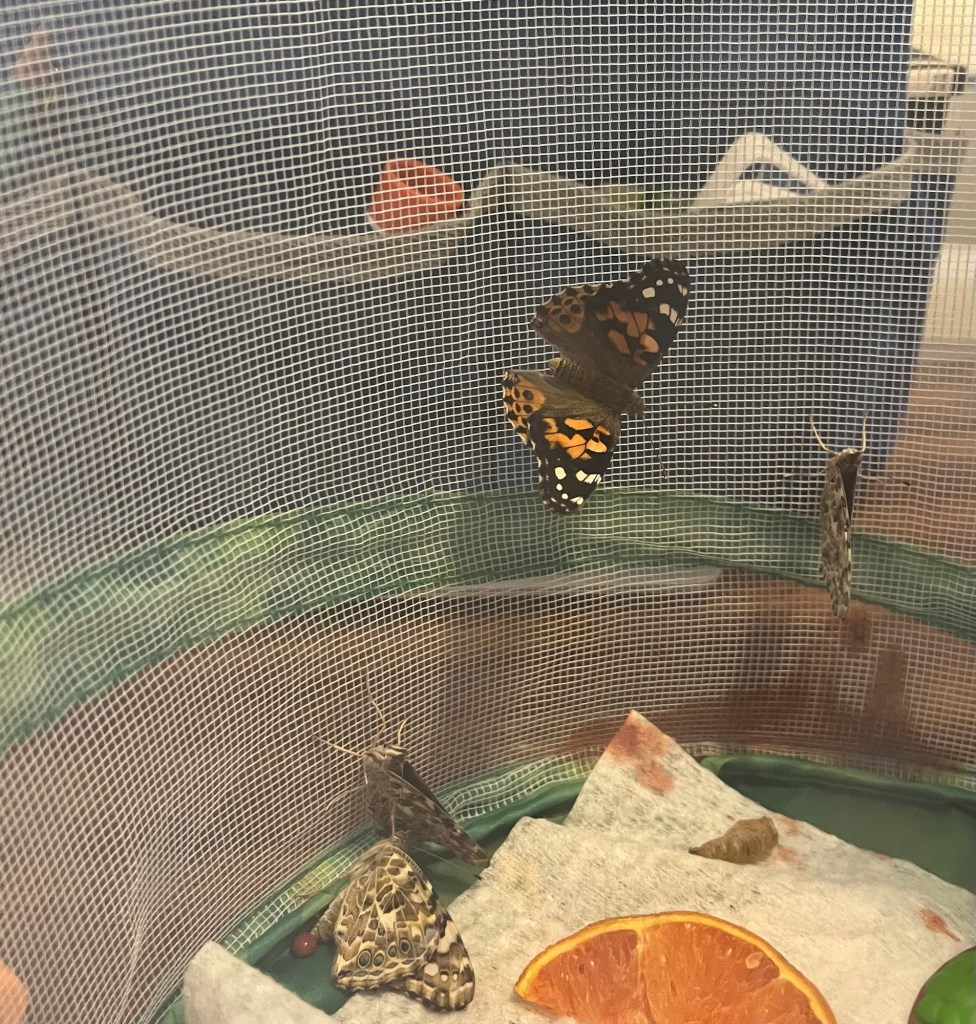
The chrysalis turned mahogany, a sure sign the butterfly would emerge at any moment. Looking closely I could see the pattern of the wing just underneath the surface of the chrysalis.
We watched, and waited. I finally sent the children outside sensing the butterfly might need some quiet, like I did.
Checking back a few minutes later, I caught a glimpse of bright orange wing. I rushed to the back door, “Guys hurry! Come quick the butterfly is coming out!”
Little feet came running from outside, big feet pounded upstairs from the office. We crowded around just in time to see it unfold perfect wings. I breathed a prayer of thanks and worship to the one who made it.
Did you know that caterpillars turn mostly to goo inside the chrysalis? But did you know some research suggests they have memories of their lives as caterpillars?
And yet miraculously they become something totally new and exquisite. What a truly amazing thing metamorphosis is.
Of course I couldn’t see it then, broken and lying on the floor as I was. Of course I didn’t have the benefit of seeing the story arc unfold.
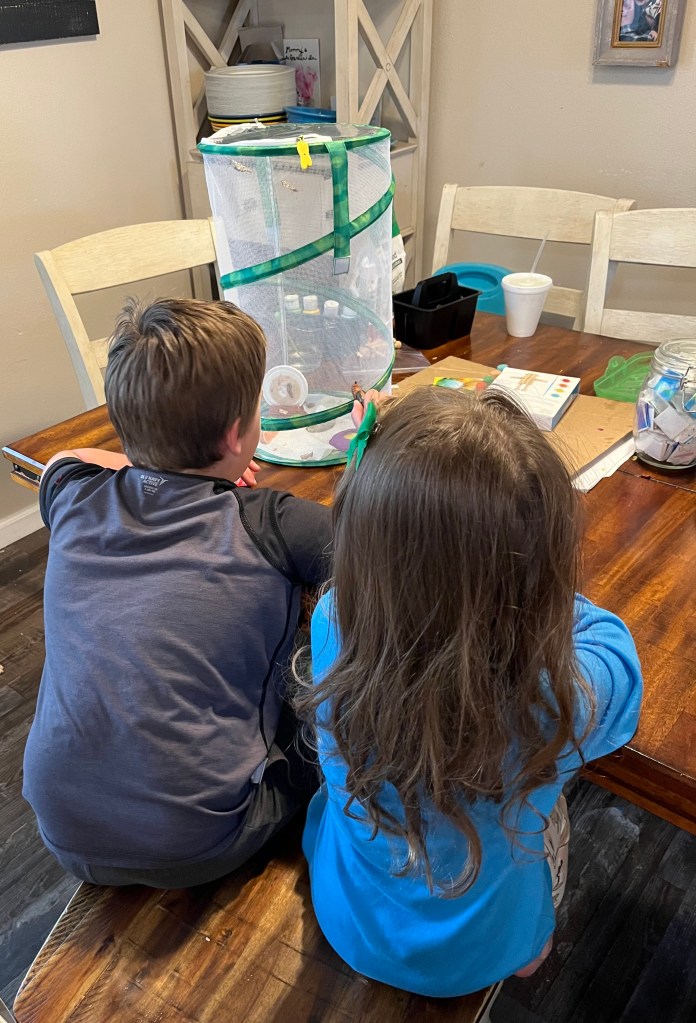
The second time I raised butterflies, I paused to imprint the scene on my heart — a tangle of arms and legs huddled around a kitchen table, peering intently. I paused to enjoy their joy. And it occurred to me that the gorgeous thing (at least in part), the thing I couldn’t even comprehend was this moment, this full and beautiful moment, this memory redeemed.
About a month before Clara was born, a normal day at home suddenly became one of deepest days I’ve ever had, complete with unstoppable tears and full blown panic. I’m no stranger to big emotions, and have spent a lot of life processing them. But I hadn’t gone “walls closing in” deep since the early days following Jon’s death.
I’ve written about tears more than a few times, but while the world is still broken, we need to talk about them. Spoiler, I’m not crying nearly as much these days. But we’ll get there. First things first.
All morning Satan barraged my heart with lie after lie. He knows just where to get me when I’m weak.
“You don’t handle life nearly as well as everyone around you.”
“You can’t reach out to someone; then people will know how messed up you are.”
“Other people have much deeper stuff going on than you.”
“You don’t always want to be the broken friend.”
“You are failing and inadequate.”
“You have no value to add to the Kingdom.”
“Why do you have such deep emotions all the time? Just push them aside.”
“Nobody wants to be around someone struggling so badly.”
“Just pull yourself together and stop crying.”
“What’s wrong with you?”
And on and on and on. Sound familiar?
Stress upon stress pressed on my shoulders. It wasn’t one earth shattering thing, but a compilation of all the ”little” things crashing down. My ear was still ringing, sometimes very loudly, sometimes quietly but always constantly. And my head had been hurting behind that ear. It was still a challenge to distinguish speech during competing noise and overlapping sounds. In a house with little children, there is almost always competing noise.
My body had begun its favorite thing during pregnancy—many contractions, early. Combined with a history of other complications, contractions meant high alert. They meant weekly visits to the OB and constantly paying attention to determine if we needed to head to the hospital. While I was immensely grateful to be carrying Clara, a high risk pregnancy is a draining place to be.
Furthermore, all of our kitchen appliances had broken at the same time. While it’s definitely a first world convenience, over a month without a dishwasher will wear a pregnant woman down. We had a warranty on it, but it still took hoop after hoop for it to be repaired.
My children are some of God’s best gifts to me. Yet the physical toll of pregnancy while caring for three little ones with need after need was overwhelming. Ever erupting chaos felt paralyzing. Ironically, I don’t mind messy play at all—paint, play doh, water, kinetic sand— you’ll find these often at our house. But that day it was too much.
And then there were other more private things. Biggish things that weighed heavily; I felt like I needed to hold it all together and hold everyone together. I couldn’t fall apart. People needed me.
There was also a little disappointment regarding a writing opportunity, but you know sometimes it’s the small straw that breaks the camel. As my mind and emotions spiraled downward, my dear, small ones bore with me so beautifully, but Mommy being a sobbing mess all morning left their hearts nervous and unsteady.
Henry touched my face and said, “Mommy crying.”
Charlotte became quiet.
And Hudson became angry.
I sat on the couch and watched Henry dump plastic ware all over the floor and then use it to scoop kinetic sand into a bowl. He was playing purposefully, though not skillfully. But I didn’t have the energy to get up and help him, or clean up the mess.
The scales finally tipped around lunch time. I was working on mac and cheese, mixing ingredients in with the burner off when the tell tale noise of fighting children echoed through the house. I sighed, and went to investigate. Suddenly I heard the unmistakeable sound of uncooked macaroni being poured and the cry of a hurt toddler.
I rushed back, panicked that Henry had burned himself. He had not, but had pulled a chair to the stove, gotten the half full box of noodles (about a pound) from the island and went to town. He was completely fine, but it was the dry noodles all over the floor, the stove, and in the pot that did me in. I couldn’t breathe, and the walls closed in. I sank to the floor, and let the primal scream come. I can remember only two or three days of panic that big, ever.
When my mother-in-law answered the phone, I could utter only three words, “I need help.” I scared her half to death, but she said, “I’m coming. I’ll be right there. But are you ok?”
“We’re all physically ok,” I managed. I heard her sigh of relief.
And she came, no questions asked. She helped with children. She washed dishes and swept the floor. And she let me talk and talk. I also jotted two texts— one to a friend and one to my other mother-in-law (y’all know Jon’s family are still family right?) asking for prayer.
The pit was deep, so deep it was impossible to climb out on my own. And I couldn’t preach my way out of it either. I tried to speak truth to myself but it bounced off the invisible wall surrounding my mind.
At my next OB appointment, I mentioned the panic and commented, “I think we need to keep an eye out for postpartum depression after the baby is born.”
But I was already struggling with it.
It took me four babies to fully understand postpartum depression. I wish had known more about it three pregnancies ago. I might have understood why I felt so crazy. And why in shame I wondered, “Who is this rage monster? Because it’s definitely not me.”
Sure, I had read about it. Sure, I had completed the depression scale at the OB office at my six week follow up. Looking back, I know I struggled with postpartum depression far more than I realized.
Did you know that depression can actually set in during the third trimester? (Raise your hand if macaroni ever caused a guttural scream.) And that it can be worse with each pregnancy?
Did you know that it can look like anxiety and moments of intense rage?
Did you know that excessive shame, guilt, being often overwhelmed, and feeling like a failure are also signs of postpartum depression?
Did you know it can take up to two years after pregnancy for a woman to feel like herself again? If you think about the ages of my children, I’ve either been pregnant or breastfeeding (with brief seasons of respite in between) for the last six years. According to that measure, I haven’t been “normal” for the last six years. It’s almost comical.
Add in a few other life changing experiences like the deaths of a spouse and both parents, and it’s been a wild decade indeed.
Over the next few weeks, the walls closed in, and panic consumed me several more times. More and more I shut myself in a bedroom to escape, or to keep from hurting someone. I thought about getting in the car and driving away. Not for forever, but at least for an undetermined amount of time.
Intrusive thoughts slipped in. “What would life look like without me in it?” I didn’t formulate a plan, but the depths of my thoughts scared me.
But there was grace to fight back.
I sent messages to family and friends to pray. I reached out to the ladies at church. They spoke truth and grace and peace. But I knew I needed to talk to the doctor again.
“Are you willing to try medication?”
“Yes, I am.”
I grew up with a parent who struggled for years with undiagnosed depression, so I had always told myself it I ever needed help I would get it. I know what depression does to a family. And I would not let it break mine. I tried counseling before and after Henry was born, but that particular counselor was a joke. I’ve also put in the work of reading parenting books, taking classes, processing past hurts, and applying the gospel.
Medication is not the answer for everyone or in every situation. But for this season, it is an instrument of grace. Ultimately it is God who lifts us out of suffering. Medication is one tool among many to fight a very real, biological problem.
I share this detail because someone might need to hear it. It’s time we talk openly of such things. I decided to start an antidepressant for the sake of myself, and for the sake of my family. The depths of my thoughts, taking care of three children, and edging ever closer to the birth of a fourth demanded urgency.
“But Ami,” says the hypothetical naysayer, “You went through the death of a spouse and never needed medication?”
“Yes, but I had hours upon hours to process, to weep, to write, to untangle the lies. No one needed me, and there weren’t four children clamoring for my attention.”
If my body hurts, it’s ok to get help. If my mind hurts me, it’s also ok to get help. Medical science is a gift of common grace. Living in a time when we have a better understanding of the brain is also grace.
It’s astonishing how steady and even my emotions feel this postpartum. Kindness and patience flow. I had forgotten what it felt like for laughter and play to be easy. I think I had gotten used to a lower baseline of happiness, and thought “This must be the way I am now.” Joy in my family, my calling as a stay at home mom, mundane tasks— all of it is so much fuller. Gone are intense swings between tears and anger, and the fight for joy.
I don’t sit in a worship gathering with my children (for our church is family integrated), and feel consumed with anxiety about what others think of me or them. I don’t worry that people don’t want to be my friends.
I can remember the truth of who I am in Christ. Words of grace and peace fill my heart, rather than words of shame and failure.
Though it still bears all the signs of life with small children, my house doesn’t feel like chaos. I see the messes, but they don’t crush me. Bringing order to my little corner of the universe is much more joy than drudgery.
I don’t feel barraged by lies.
I don’t feel broken.
In short, I feel a lot like the Ami I once knew.
But isn’t there also a spiritual aspect? Of course there is. Pregnancy, postpartum, and parenting (yay unintentional alliteration!) have all taught me so much about Christ.They have an uncanny ability to reveal sin. I have needed to be, and still need to be sanctified. I have needed to rest in the grace of redemption.
However, we cannot deny the reality that there are also biological factors at play in these seasons. We cannot deny depression as a real issue linked to faulty neurotransmitters, and fluctuating hormones. Unlike I was taught so many years ago, I do not believe all problems are purely spiritual or purely physical.
I know how to preach the gospel to myself and counsel myself with the truth. I’m no stranger to defeating lies. But the intense emotional swings of late pregnancy and postpartum, made it almost impossible to get truth in. I wonder if Satan uses things like fluctuating hormones to make us more susceptible to his lies.
I don’t despise the deep times though. For God has used them to illumine my heart with truth after truth. It’s in the valley that I’ve seen Jesus the most clearly. It’s the deepest days that have often produced the most fruit in my life. It’s the deepest days that have caused me to write. I know they are necessary and good. He holds our tears in a bottle. He grieves when we grieve. For now, however, it is good to not constantly wrestle with my mind.
It is good for my family to have the me I want to be back. It’s good for my family to have the me who remembers who I am—a new creation, redeemed, justified, adopted, cherished, beloved, saint.
I never thought I’d actually struggle with depression. I know Jesus, and he is our only hope in life and death. The gospel is true and it changes everything. Yet, I had to acknowledge there was something seriously wrong. Something that was not just spiritual. And it doing so, it is so much easier to apply the gospel to life and remember it is true.
So I cry I lot less these days.
“I waited patiently for the Lord; he inclined to me, and heard my cry. He drew me up from the pit of destruction, out of the miry bog, and set my feet upon a rock, making my steps secure. He put a new song in my mouth, a song of praise to our God. Many will see it and fear and put their trust in the Lord.” Psalm 40:1-3
Medication or no medication, I am confident in the Rock. The work of deliverance belongs to him.
God moves toward his own.
He inclines to me.
He hears my cry.
He lifts me up
He secures me.
God is not apathetic to cries for mercy, rather he delivers us and sets us upon an unshakeable foundation, that is the Christ. He drew me out of the pit long ago in salvation. And he’s drawn me from the pit of despair many times since then.
“As for you, O Lord, you will not restrain your mercy from me; your steadfast love and your faithfulness will ever preserve me!” Psalm 40:11
Unrestrained mercy.
This is how he moves toward a humble heart. His mercy is not on a leash. We are ever recipients of unchanging, loyal, always giving what is best, faithful, love. With the Psalmist I praise him for his steadfast love. I praise him for relief, for hearing my desperate pleas.
While the world is still broken there will still be tears. And panic. And worry. And shame. We fight these battles with the truth. They have already been won by Jesus who died and rose again. The truth changes things. But when something biological creates a force field against the truth, we fight with other tools also.
One day even minds will be redeemed. One day there won’t be deep days. Jesus is making all things new. Ultimately he is where my confident expectation lies.
The other day Henry played gleefully with dry macaroni, pouring it back and forth between bowls, stirring it, and shaking it in measuring cups. Of course, as sensory play always does, it exploded across the living room floor.
I glanced down at dry noodles everywhere, and smiled.
His hands were sticky and peanut butter smeared his cheeks. Strawberry jam coated the corners of his mouth. As I had done a thousand times before, I washed chubby hands and a bright-eyed little face.
“Mama, why you wash me hands and me face?”
“Well buddy, I want to take good care of you.”
“Why you take good care?”
“Because God takes good care of us.”
“Why God take good care?”
“Because He loves us.”
A short exchange, but my words penetrated my own heart. God takes good care of us.
Pinpointed Care
It’s who He is: a God whose care is not only lavish but precise. Jesus fed thousands from a little bit of lunch, but He also embraced individuals who longed to be touched. He healed sickness, but waited to come until Lazarus was dead so He could display deeper, more extravagant care (John 11). He comforted some and admonished others.
Jesus was not a far away philanthropist, tossing mass-produced, look-alike blessings from the sky. He taught with words His audience could understand, perfectly pinpointing the need of each heart.
His care in our lives is also precise. Shifting scenes come into focus, evidence of His precision: Specific Scripture passages spring to mind as I pray for comfort. A financial need is met at just the right time. A spectacular sunset radiates across the sky. A surgeon skillfully removes a tumor. A woman praises God at her husband’s funeral. A baby sleeps through the night. And on other nights the weary mama has grace to rise yet again, praising God for quiet, stillness, and soft baby skin nestled against hers.
All are gifts of precise, tangible grace, flowing abundantly for the day when they’re needed.
Inexhaustible Compassion
How marvelous it is that God never has to prioritize whose need is bigger or more important? He has the power and compassion to meet billions, trillions, quadrillions—an infinite number of needs at once.
My children are close in age, so I’m constantly evaluating whose need is more urgent—one calls for help in the bathroom, the toddler has bumped her head, and the distraught baby needs to eat. Sometimes I’m not exactly sure of the best response. I’m talking about total meltdowns when a two-year-old’s dinosaur sheets are in the washing machine or how to handle it when shouts of “It’s mine!” “No it’s mine! I had it first!” reverberate down the hall. It’s exhausting. And exasperating at times.
Praise God, He’s never exhausted or exasperated by the constant care his children need! He already met mankind’s biggest need, through the death, burial, and resurrection of Jesus. So rest assured, your needs are not too great. Or too small.
God is also a Father characterized by perfect compassion toward his children. “For he knows our frame; he remembers that we are dust” (Psalm 103:14 esv). He understands our weaknesses and gets down low to meet us there (Isa. 57:15). He is a shepherd who tends his flock with gentleness—especially the young (Isa. 40:11).
His care is precise, powerful, and perfectly compassionate—all because He loves us. Because Jesus took care of His own even to the cross, we know kindness when we deserve wrath, grace when we deserve judgment, and gentleness when we deserve rebuke. As a result, our care can reflect his care. We take good care of our own.
By this we know love, that he lay down his life for us, and we ought to lay down our lives for the brothers. (I John 3:16 esv)
Caring for the Needy
By sacrificially meeting our children’s needs, we get to show a fraction of God’s lavish love. God doesn’t leave His own in their filth, so even the physical act of cleaning our children is a kind of mercy. Of course, small children need a parent to do these things because they can’t do them on their own. How quickly they would succumb to their own excrement. How pervasive is our filthiness if not for Christ!
Sadly, not all children are well cared for by their parents. In a broken world, even the natural desire to provide and care for our most vulnerable is marred. Most folks in our culture are rightly appalled by horrific stories of abuse, but many still promote a “children are jerks” culture.
A medical professional sat across from me talking about his young son, “I love him, but sometimes he’s a total *expletive*.”
I made my next appointment with another doctor. Children are image bearers and loved by God. They are our little neighbors too.
May our parenting flow from a life overflowing with the fruit of the gospel—that is “love, joy, peace, patience, kindness, goodness, faithfulness, gentleness, and self-control” (Gal. 5:22–23). We can be counter-cultural by not berating, shouting at, shaming, or demeaning our children.
Furthermore, remembering God’s care produces so much joy in the mundane. Instead of merely washing hands and faces for the seemingly millionth time, we get to touch a hand loved by God and cleanse little faces made in God’s image. What an attitude changer on a hard day!
Do we begrudge them their neediness, become frustrated because they inconvenience us and demolish our “plans,” or do we realize the potential to show them the heart of Jesus?
We cannot meet their spiritual needs, but by tenderly, generously, compassionately, and kindly meeting their physical needs we reflect the One who can meet all their needs.
Unseen moments, then, become acts of worship and reflect the heart of God.
A parent’s days are filled with unseen moments, but they’re holy moments, nonetheless. Holding a hand in a parking lot, rocking a sick baby in the night, giving a toddler clean clothes after a potty accident, changing a blowout diaper, loading a dishwasher—all reveal something about God to the people around us. Whether we like it or not, the way we parent contributes to our children’s perceptions of themselves and of God. Unseen moments, then, become acts of worship and reflect the heart of God.
Is He a God who is rough and gruff? Is He fickle, some days speaking calmly and others flying off the handle? Does He grudgingly get up to answer our cries?
Sometimes I’m fickle, selfish, and moody, but “Jesus Christ is the same yesterday, today, and forever” (Heb. 13:8). Amen.
Commenting on Romans 2:4, Jared C. Wilson writes, “God’s kindness is meant to lead you to repentance. Not his law, not his berating, not his exasperation or his cajoling. His kindness.”1
I wish I could say I’ve never been guilty of berating, cajoling, or exasperation. But because the Holy Spirit indwells believers and the gospel empowers us, we can respond to our children with kindness and gentleness. We can respond rather than react.
But what about when we sin against them? What about when we don’t meet needs tenderly or do give in to anger boiling inside?
Well, God’s kindness leads us to repentance also. He is notoriously patient and long-suffering, and his compassions fail not. Over and over his mercies are new (Lam. 3:22–23). He is near the contrite and lowly because Jesus already paid the penalty for selfishness, angry outbursts, frustration, desire for convenience, and all the other parenting temptations that come our way.
When we sin we are encouraged to bring our mess to Jesus because he will know just how to receive us. He doesn’t handle us roughly. He doesn’t scowl and scold. He doesn’t lash out, the way many of our parents did. And all this restraint on his part is not because he has a diluted view of our sinfulness. . . . His restraint simply flows from his tender heart for his people . . . rather than dispensing grace to us from on high, he gets down with us, he puts his arm around us, he deals with us in the way that is just what we need. He deals gently with us. —Dane Ortlund, in Gentle and Lowly2
On our best days and on our worst, He is our intercessor and advocate who constantly brings us before the throne, His own righteousness covering us (1 John 2:1–3, Heb. 4:14–16). He silences the accuser, and we recall who we are—called, capable, new creations, redeemed.
He has cleansed us from our own filth. More than that, He moves toward us and embraces us, and is committed to the work He began. He will sanctify his own (Phil. 1:6). Therefore, we walk forward without shame.
So take heart friends, He takes good care of us.
1 Jared C. Wilson, The Imperfect Disciple: Grace for People Who Can’t Get Their Act Together (Grand Rapids, MI: Baker Books, 2017).
2 Dane C. Ortlund, Gentle and Lowly: The Heart of Christ for Sinners and Sufferers (Wheaton, IL: Crossway, 2021).
Giggles pealed through the air contrasting the rhythmic break of waves against shore. Children ran, full of joy, letting water crash against their ankles. Shovels plunged into sand. Fingers and toes curled, greedily exploring the texture as if they were made for sand and sea.
“Look at this beautiful shell Mommy!” They showered me with shells indiscriminately, gifts of grace from precious hearts.
“Mommy look at those huge birds!” Pelicans glided across the water in single file, gracefully swooping down. They were proud, showy, confident of their place in the world.
“There’s a man on a skate board, and he’s using a parachute in the water!” My nearly three year old who is blessed with the gift of many words, gazed in wonder at a kitesurfer. I marveled at her apt description of a concept she’d never seen before. Every minute was fresh with discovery. Every new site met with delight.
I drank in the scene admiring the horizon stretching endlessly, intersecting with the very curve of the earth. Ocean, sand, sky— together resplendent—they couldn’t help but praise the one who made them. How naturally worship flooded my heart! What a powerful, majestic, God I have! Even the beauty of creation is a gift of grace.
I had waited for this day. Illinois has some lake beaches, but they’re kiddie pools (or cat pools as my little ones say. See the sweet misunderstanding there?) compared to the ocean. I longed to take my children to the ocean, and their first experience with it was every bit as lovely as I imagined it would be.
Playing in the water, building sand castles, eating sandy snacks—there was no quiet contemplation, or nose buried in a book. But the beach with kids was delightful.
Gears of time turned, and in my mind I contrasted another, earlier day.
It was windy, the precursor to rain and storms. I lay on a beach towel, soaking in the rays, yet aware of the more than average wind. Sighing, I closed my book, and propped my chin on folded arms. From my vantage point, I had an up close and personal, lavish view of nothing more than sand.
Alone with my thoughts, I contemplated “the long dreaded day”- the day he would be gone longer than we had been married. Two years, eight months, and three days I was married to Jonathan Atkins. Two years, eight months, and three days he had been gone.
My mind swirled with implications. “I’m facing a day most widows never experience. So many get to be with their husbands for decades.”
Sand whirled, reacting to the force of the wind. My face inches above the beach, I searched for an indiscernible pattern, noticing individual grains whisked along by something outside themselves
“How precious to me are your thoughts, O God! How vast is the sum of them! If I would count them, they are more than the sand. I awake, and I am still with you.” (Psalm 139:17)
If I tried to count the grains of sand in the square foot in front of me, it wouldn’t take long to realize the futility of my endeavor. How ridiculously more impossible to number all the grains of sand on every beach and under every ocean!
But a string of zeros marching across my imagination is the best I can do to comprehend the number of God’s thoughts toward me. Now multiply that by seven billion people on the earth. It’s unfathomable. God has countless thoughts about me? About each image bearer?
All I can do is marvel.
Writing Psalm 139, David overflows with astonished wonder. How can it be that the God who is glorious and transcendent is also personal and intricately involved in his small life?
“The intimacy of David’s relationship with God is put on beautiful display through this Psalm. David knows that God’s care for him is so deep and thorough that every step he takes, every word he speaks, is known fully by the Lord who has numbered all of his days before they began. Indeed his days began as God formed him while yet in his mother’s womb. His very inward parts and every aspect of his life have been designed by God himself. No matter where David may travel, far or wide, he knows that God’s Spirit is always with him, that God always knows the situations he is in. To imagine the detailed and exhaustive nature of God’s thoughts toward his own children, as David here exemplifies truly is precious.” (1)
His thoughts about us are vast, and he deals with us in more unique and intimate ways than any human ever could. By God we are thoroughly known and and still thoroughly loved (2)
“In your book were written, every one of them, the days that were formed for me, when as yet there was none of them.” (Psalm 139:16)
Before I was born God established the course of my life, a tiny though meticulously planned subplot in His epic redemptive tale. He was sovereign over the length of days I had with Jon. He orchestrated our meeting, and His timing was perfect. To wish for more time, is at its root to doubt God’s character. It is to doubt the vast, detailed, and utterly perfect nature of His plans.
There were times I did doubt. But God always brought me back.
Even if I stopped being known as “Mrs. Atkins,” or slowly became surrounded with friends who didn’t know Jon or the me I had been with him, I was still known.
It had taken me a while to figure out who I was after death ripped me in half. But as I walked farther down the path away from the valley of death, I started to look forward. It was ok to be me without Jon.
For truly my life is hid with Christ on high (Galatians 2:20). As I gaze on him, I know who I am.
I closed my eyes, breathed in the salty air, and rested in the beauty of being fully loved and fully known. On a day I long dreaded, I realized I had nothing to fear.
Fast forward, back to children playing in the sand. Sorrow mingles sometimes, but on this day there was nothing but joy and laughter. I watched my husband, David, playing just as gleefully as the kids were, scooping them up then dipping them in the waves.
I was given two years, eight months, and three days with Jon. To date I have had five years, 10 months and 17 days with David. We’re closing in on six years quickly.
How much more striking is the narrative of my life written by a perfect, sovereign hand than what I could ever think to pen. I wouldn’t have chosen death. But without it I would never have this man, these children.
This is a story of two contrasting days drawn together by a common theme. One day lonely, quiet, wondering what was next, fearing the piling on of days and Jon becoming a background character. And a second day, full of laughter, contentment, and the boisterous play of three under five.
But both days drew my heart to worship. Both reminded me of an unfathomable God who also knows me precisely. The same God who created vast oceans and innumerable grains of sand knows me.
I tend to share my struggles openly and deeply. I want to be as known as people will let me be. However, though our culture loves the words “real” and “authentic,” we only want them to a certain extent. Somewhere there is an invisible line we dare not cross.
Sometimes we want just enough of others’ messiness to feel better about ourselves. Other times we truly do care, we just have no idea how to respond. Too much confession, too much grief, too much depravity makes others uncomfortable. And besides who wants to always be the “broken” friend? So sometimes I do what we all do— put on my respectable face. Don’t overshare. Don’t weigh everyone down. Don’t be “too much.”
But it is not so with God. Even if I tried to put on my respectable face, he knows all of my ugliest parts; he is not afraid of them. And he loves me anyway. I have learned I can always run to God with my sin and struggles. I need not hide because the transcendent God, bowed low enough to be born a helpless newborn and bowed even lower still to die on the cross. He always meets me with mercy and grace.
Although he knows everything about me, he still dwells with me. Though he has countless thoughts about me, he remembers my sin no more (Isaiah 57:15, Hebrews 8:12).
All I can do is marvel and respond with lifted hands.
“What is our hope in life and death?
Christ alone, Christ alone
What is our only confidence?
That our souls to him belong
Who holds our days within his hand?
What comes, apart from his command?
And what will keep us to the end?
The love of Christ, in which we stand.” (3)
Lying crumpled in the valley of death, Christ is the hope. Rising, limping, staggering up the slope, Christ is the hope. Looking forward as the path winds around the bend, Christ is the hope. And even on bubbling with joy, resplendent, playing by the sea days, Christ is the hope.
And this hope is not nebulous or wishy washy. It’s not the way our vernacular uses hope. “I hope it doesn’t rain” or “I hope I can get that stain out your clothes.” We think hope is a “maybe.” Perhaps something good will happen, but it isn’t guaranteed.
However, true hope in Christ is confident expectation. It is something steadfast, sure, guaranteed. He is exactly who he says he is and will do exactly what he has said he will.
My confidence may be shaken. It may even start to crumble. But hope is built not on my ability to believe, but on the one who holds me, you, every blade of grass, every galaxy, and every atom together. This God who is hope knows every fear, worry, and every wretched thought I have. He knows the beautiful ones too. Fully known, yet fully loved. This God purchased hope with his blood, and he lavishes it on my soul like innumerable grains of sand poured on every shore and under every ocean.
To be known. To be thought of countless times. To be met each day with precise hope.
All I can do is marvel.
1 Commentary on Psalm 139, ESV Gospel Transformation Study Bible: Christ in All of Scripture, Grace for All of Life: English Standard Version (Wheaton, IL: Crossway, 2018).
2 Timothy Keller and Kathy Keller, The Meaning of Marriage: Facing the Complexities of Commitment with the Wisdom of God (New York, NY: Penguin Books, 2016).
“It’s holy work,” my heart whispered to my mind as I walked down the hall toward screaming siblings.
“It’s holy work,” the Spirit said as I knelt down to empathize.
Holy work.
Sometimes I get it right. Perhaps my children smell the fragrant aroma of the riches and grace of Christ. Perhaps their subconsciouses catalog the beauty of a redeemed life.
It’s holy work to show them Christ, to be their first and deepest exposure to the gospel, to give them their first constructs of what God is like.
Sometimes I get it wrong. They surely smell the stench of sin.
The trenches of daily life are the litmus test. Does the Jesus we proclaim on Sunday permeate our days on Monday?
We take the call to make disciples seriously. The work of shepherding, a holy calling. Jesus, the gospel-they are not add ons, not once a week “gave my tithe, filled my pew, did my duty.”
Jesus is our life.
In the same way speaking to a hundred women or leading Bible study is holy work, so is wiping another bottom, reading another book, washing another dish.
And loving them when they seem unlovely is an act of grace, a gift of worship.
I push back against mediocre, “Mommy needs a glass of wine” parenthood.
This much unseen, soil cultivating, seed planting work is valuable and important.
The messages they receive at home become a part of who they are. What am I telling them about their identity?
At a recent medical appointment the practitioner spoke about his young son, “I love him, but sometimes he’s a total expletive.”
I switched my next appointment to another doctor.
Because the little ones are image bearers also. They are gifts of grace.
They are sinners in need of Savior. But they were created for good and honorable things.
They were created to know the One who shows them their true selves.
I love light bulbs, the “aha” moments when all of a sudden two truths align and things make sense. I’ve been pondering a big one that feels life changing, or at least brain changing.
But first, a little background. Sanctification is becoming what you have already been declared to be. (Through Jesus, and only Jesus, you are justified or declared righteous.) You could call it spiritual growth or growing in Christlikeness. It’s a life long process. The Holy Spirit works in the heart of a believer, and the believer responds.
Here’s the flip of the switch.
What if sanctification isn’t just heart change but also literal brain change? What if “work out your own salvation with fear and trembling” is in part re-wiring neural pathways?
What? That’s crazy!
Ok, I see you scratching your head. Don’t write me off just yet.
Have you ever heard the phrase “Neurons that fire together wire together?”
I have in several contexts, but I confess I haven’t really gotten it.
During my brief CrossFit days (I wish I still did it) I heard it in context of weight lifting; the more repetitions you do, the more automatic a movement becomes.
I’ve also heard about firing and wiring from occupational therapists as they provide deep pressure on arms and legs, from head to toe, and across the body. By activating those neurons together, they are teaching a child to regulate his nervous system so he can calm and focus.
Recently I heard it in a “Discipline that Connects” course (from Connected Families) David and I are taking. And this time all the bells and whistles went off in my brain.
Messages sent to the brain create neural pathways, and repeated messages fire faster and travel more easily. The more we use a neural pathway, the more it becomes a super highway.
Therefore, the more I am “large and loud” or angry and frustrated with my children, those responses are more easily triggered.
If I want to change the pattern, I need to change the pattern. My brain needs new messages. And it needs the repeated messages of interacting calmly and connecting with hearts before discipline.
My heart exploded with understanding and praise to God for a few reasons! Over the last four years I’ve been on a mission to seek God’s heart regarding shepherding our children. I have ready many books and studied Scripture as David and I have built our overall philosophy.
I have also been “putting in the work” to understand and process my own childhood trauma.
All of this creates and reinforces neural pathways.
As I have learned strategies to remain calm in high pressure parenting situations, I am literally re-wiring my brain. And the more “reps” I do across different circumstances, the more I’m becoming who I want to be.
When I kneel down and talk to my children instead of shout at them, neurons are doing some important highway construction— in my brain and in theirs.
I am encouraged that something physical is happening. Maybe if someone measured brain activity there would be a difference.
There is growth even if it feels SO slow sometimes. There is growth even if it feels like construction is at a stand still or an excavator dug a hole across the path.
I know my understanding of brain science is simplistic, but maybe, just maybe I’m also dismantling some neural pathways related to my own abuse and neglect.
But there’s better news! For a Christian, it’s even bigger.
If the strategies I am learning are rooted and grounded in the gospel, this is not mere behavior modification.
As I repeatedly remind myself of the truths of the gospel related to parenting (or any other struggle), those truths send neurons firing across my brain. The resplendent reality of the gospel physically changes my brain. What I actually believe about God, myself, and others physically starts to change.
Over many years a highway (among others) called “Identity” has formed. Construction on it will probably never end—an I-90 in my brain—but it’s getting bigger and better.
Perhaps brain change and heart change are connected.
Only God changes the heart, but as thinking changes so does the heart. What a complex mystery. Sanctification is God’s work. But I respond by recalling truth.
When I tell my small people…
“You are made in God’s image. Jesus loves you and died for you. He came to save sinners like you and me.”
Or “Mommy needs Jesus also. Let’s stop and ask God for help.”
Or “I know you are having a hard time. But I love you.”
Or “You are called and capable. You are responsible for your actions.”
Or “God created you. He can use your big heart, persistence, and determination for his glory.”
Or “I’m on your team. We can figure this out together.”
…perhaps those repeated messages, will one day lead to heart change. Perhaps they will internalize the truths firing across the super highways in their brains.
That’s really good news.
Maybe all of this is a little too nerdy. But imagining neurons racing across my brain, is immensely encouraging. Some things are rewiring, some past highways demolished. God is a work in me. And I will keep actively repeating messages of truth.
Ephesians 4:20-24
“But that is not the way you learned Christ!—assuming that you have heard about him and were taught in him, as the truth is in Jesus, to put off your old self, which belongs to your former manner of life and is corrupt through deceitful desires, and to be renewed in the spirit of your minds, and to put on the new self, created after the likeness of God in true righteousness and holiness”
Recently a friend wrote that about her own shifting redemptive story. It struck me that most of the dearest people in my daily life don’t know my grief. It’s been nine years since the grace of open hands, “He’s yours, Lord.” Nine years since grace even in a guttural scream “Help me God not to hate you for this!”
I’m a different person. Friends and family know the restored Ami, I think, the one who bears radiant scars but not the crushed Ami.
They know the fruit of Jesus’ healing. David’s wife. Mom of Hudson, Charlotte, and Henry. Driving a mini van, doing all the mom things. Navigating the ups and downs of life’s current season. I’m as reflective and introspective; the themes are just differently shaped.
But they only know of Jon and have only heard the stories.
It’s been about five years since I’ve lived near the ones who were there in chasm with me. (Wouldn’t it be lovely if all the people I hold dear lived in the same place?) And I’ve been married to David twice as long as I was married to Jon.
What a drastically different life!
There’s astonishing joy as the valley of death recedes further and further in the distance. But there’s still so much of me that wants the whole story known.
Jon, his death, widowhood– they are still a large part of who folks see today. I want people to see all God has done.
It’s not brave to talk about Jon and all the aftermath of his death. It never has been. It’s just how God created the inner wirings of my brain. Verbal processor, consummate oversharer. I like being known.
I’ve long adopted a “rip the bandaid off” strategy when I talk to new friends about Jon. I quickly and awkwardly bring up his death as part of a bigger context. And then I make them laugh, moving on to something else.
Maybe it helps people absorb the shock a little. And I hope it portrays, “I’m not afraid to talk about this, but I get that you can handle only so much from someone you barely know.”
The ache of grief is rare these days, though occasionally it takes me by surprise. Even the events of the emergency room are dulled. Random things cause twinges of sorrow though.
It’s also been awhile since I grieved the children Jon and I never had. Now, I wish he knew my sweet babies and could laugh with my dearest Dave.
I think of Jon and smile. I see him scouting a long line on Black Friday, asking everyone, “Are you going to buy a crockpot? That’s what we’re getting.”
I see him doing exaggerated stretches, bouncing with excitement. And I break into a wide grin as I picture him power walking (you know, like the mall walkers with their hips and arms going) as fast he can to the back. Not another shopper in sight, he swoops down, grabs the box lifting it high. “I got the first one!”
No one else wanted a crockpot.
Last night I rocked my youngest, thinking of all that’s past. Again I praised God. Again I thanked him for meeting me in valley, for keeping me when I didn’t want to be kept. Again I thanked him for teaching me Christ in joy and in sorrow, in the power of his resurrection and in the fellowship of his suffering.
Hudson has had a lot of questions about death and Heaven recently.
“Mommy will I get to meet your first husband Jon one day?”
“Yeah buddy, if you know Jesus you will.”
“I know Jesus.”
Jon had that child-like confidence also. Friends and family may not know him, but he’d probably say, “I want you to know Jesus, anyway.”
In the first days, months, and even years, grief demanded to be felt. At first all consuming, then later coming in waves, it was a typhoon I could not circumvent. Sometimes it was best to let the waves crash me against the rocks. I needed to feel every ounce of sorrow, every iota of pain that was even physical at times. No, of course, I did not want to be in the valley of death, and yes there were so many months I didn’t think I’d make it out alive.
But somehow even in the crushing, tsunami days I knew that if I was going to see redemption, if I was going to see God do something with the ashes of a broken life, I had to process the weight of grief. I couldn’t push it aside or bury it in a box. The only way through the storm, through the suffering, was to embrace it. I didn’t always grieve well, but to feel, and feel, and feel again was a response empowered only by grace.
There were so many more layers than I ever knew there would be, more knots to untangle, more tears to shed, more depths, more cyclical emotions. It took me longer to be ok then some people thought it should.
But there was also always more grace.
So here I am. I was a shipwreck, battered and sinking. I was a crumpled heap lying on the bottom of a cavern floor, limbs broken and splayed.
But God. But God who is rich in mercy wasted not an ounce of sorrow, but instead taught me himself in startlingly radiant ways. I learned a taste of what it was for Jesus to suffer—Christians like Philippians 3:10 “That I may know him in the power of his resurrection,” but we’d really prefer that the second half of the verse not exist, thank you very much. “And may share in his sufferings becoming like him in his death.”
But I do not desire a fake Jesus, the one who only comes in riding on a white horse. So, if I want to know the real Jesus, then I must know all of him.
Some say time is the great healer, but it’s not time, it’s Jesus. Sure, time has a way of blurring what once was crystal clear. But only Jesus truly heals.
Grief does not demand much attention these days. (I have two toddlers who do that just fine instead.)
But there ripples every now and then. This week a picture of some throw pillows sparked a good cry. And I feel sad that Jon never knew my wonderful David, or met my beautiful children. I know it’s a weird, thoroughly illogical response because if Jon was still here these three would not be.
I miss him still and always will. I love him still and always will.
But as Spurgeon said “I have learned to kiss the wave that throws me against the Rock of Ages.”
It is true that joy comes after sorrow, light after darkness, and calm after the storm.
Today grief feels a little more palpable than it has the last couple years. I’m not completely sure why, but perhaps it is because the more years that pass, the more life with Jon feels like a lifetime ago.
Perhaps it is also related to being home by myself with two little people who have strong needs. (You know I delight in them, but you also know that days with a toddler and an infant can be tricky. I’m not always as patient as I want to be etc.)
Perhaps it is also because sometimes life is one hard thing after the other, and maybe I’m slogging through this season some days. I guess I’m reminded that the world is broken. It’s not the way it’s meant to be. And it makes my heart sad.
But today I’m also acutely aware of Christ’s body broken for us, so that all that’s wrong will be made right. After Jon died, it was awhile before I started serving in any type of ministry, but one of the first ways I served again was by making communion bread. I loved that our church used handmade bread. It was something simple I could do for others even when I was still struggling. The weeks I was assigned to bake became sweet times of worship and prayer.
Tomorrow we get to celebrate communion with our new little church replant for the first time. Hooray! So my little helper Hudson (don’t worry, I washed his hands thoroughly ) and I baked bread. How beautiful to get to share Jesus with him as we worked. He doesn’t understand yet, but I pray one day he will. And as we mixed and kneaded, I turned my heart to prayer.
The bread is a symbol of Jesus’ body that was broken. Christians take the bread and the cup as a reminder of what Jesus accomplished on the cross.
“The body of Christ broken for you.
The blood of Christ poured out for you.”
His body was broken and his blood shed, so death and sin would be defeated.
So while I miss Jon today, I’m also surrounded by some glimpses of renewal and reversal. Two babies to snuggle. My steadfast, kind, loyal, fantastic David.
We weren’t meant to experience death, and praise God, one day it will be eradicated forever. And all that’s hard will slip away. For the believer in Jesus, no more just slogging through. Only joy. Only radiant happiness.














 So my little helper Hudson (don’t worry, I washed his hands thoroughly
  ) and I baked bread. How beautiful to get to share Jesus with him as we worked. He doesn’t understand yet, but I pray one day he will. And as we mixed and kneaded, I turned my heart to prayer.
 When Mercy Found Me